GALVmed meets… Ruben Mushao

Ruben Mushao lives in Mundara village in Longido District, a Maasai area in Tanzania. Since he began vaccinating his calves against East Coast fever, the number of his cows increased from 300 to almost 1000 despite the drought.

East Coast fever has a high mortality rate with cows and the disease is rife in many parts of  Tanzania. If he had not immunised his herd, “I believe the number would have been 300 cows as it had been for past years.

Today, Ruben earns a comfortable income from selling his cows. He owns two houses, a shop in his village that sells everyday household goods, a tractor that he also rents out to other farmers, and a car.  He was also able to send his 28 children to school and university. “My ambition is for my children to go to school and work in the cities and not to depend on cattle.

GALVmed meets… Korleri Thakur from Orissa, India

Newcastle disease and the elephant in the room

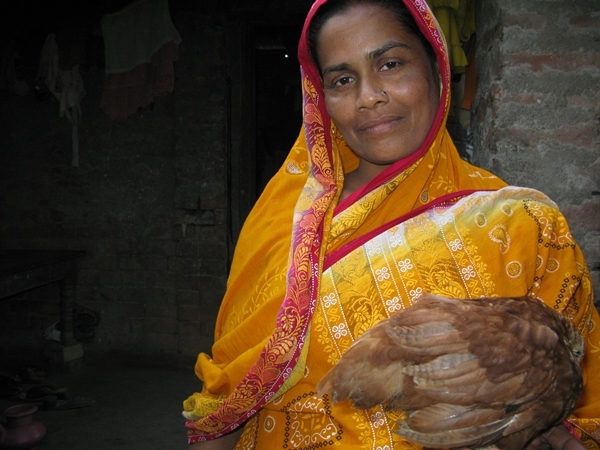
Korleri Thakur is a farmer with a jumbo-sized problem. Although   her family has four acres of land and should be able to produce enough food to support the household, the local wild elephants often destroy her crops and sometimes even knock down the hut the family lives in. This makes farmers like Korleri whose villages are located in dense forest (good elephant habitat) highly dependent on livestock and poultry for their livelihoods.

Outbreak of poultry or livestock diseases are dreaded by farmers as these can wipe out months of hard work. Last year, an outbreak of Marudi (Newcastle disease) affected 25 of Korleri’s chickens: only five survived. This experience with poultry disease has, however, made her wiser: her poultry were fully vaccinated during the recent GALVmed-supported community animal health worker training – part of GALVmed’s Newcastle disease pilot programme.

Despite keeping chickens since she was a child, she was not previously aware that timely vaccinations would help save the birds. She is now willing to spend on vaccines and medicine for poultry because she can see it makes economic sense.

Talking about the chickens brings a smile to her face. From those five birds, she has managed to increase the flock to eight. Her poultry and goats contribute food and income to the household. The birds are of the local variety (desi) and scavenge for food all over the village. The fact that the birds do not need to be fed makes Korleri happy as it saves her a lot of effort and money.

Every once in a while a cockerel that survives and grows to maturity is sold for INR 300 (US,$6.5) – a welcome addition to the household income. The cash from her poultry sales is deposited in the Suvakatti (village bank) and she plans to use this to support her children’s education and build another room for her family. She is also very proud when she has guests and can serve them her own chicken for a special meal.

Korleri has a twinkle in her eye when she speaks of the future and a major reason for her optimism comes for her colourful flock of poultry. She is still superstitious by nature and is wary of anyone seeing her birds thinking “someone is casting an evil eye on my poultry”. More importantly, however, the community animal health worker is casting a benign eye over her livestock and has helped her to avoid Newcastle disease in her flock.

Korleri Thakur is from Bayakamotiya village, Mayurbhanj District, in Orissa State, India. She lives with her husband, their four children and her father-in-law.

GALVmed meets… Niranjan Pradhan, and animal health worker from Orissa State, India

Niranjan Pradhan, 26, from Bayakumotiya village,  Keonjhar District, Orissa State, India

Seven years ago high school graduate Niranjan trained as an accountant to assist his self-help group, a role he continued to play for four years. Then PRADAN, an NGO and local partner of GALVmed, asked him to join them as a community animal health worker. He received basic training and since then has been focusing on goats and poultry in three villages.

His work includes vaccinating and de-worming, training villagers on good husbandry practices and following up on their progress. His household has five acres of farmland where they grow rice and keep 10 chickens and 14 goats. This gives him good insight into villagers’ trials and tribulations. The common diseases that he encounters are Newcastle disease, fowl pox, internal and external parasites, peste des petits ruminants and goat pox.

Reviewing what he has learned over the past three years, Niranjan told GALVmed he is trusted in the community because of his previous role in the self-help group. But there is superstition amongst some farmers about modern medicines. Smiling, Niranjan added: “Slowly, even such people have started to trust me when they see evidence of vaccinated animals being healthy, while their own unvaccinated animals fall sick.” His key lesson is that villagers are willing to pay for veterinary services for their livestock as long as they can see the results.

The main constraint, however, is that he cannot provide services and reach everyone who needs his help. The terrain is difficult and there are long distances to travel. He explained: “If there were more community animal health workers available, then the situation would be easier to handle”. Niranjan was initially attracted to the role of a community animal health worker because the money was good. Now, when he sees the results of his work in his community and the faith they have in him, he feels happy and motivated. As he told us: “They respect me, they have faith in me and that gives me great satisfaction.”

Community animal health workers

A cadre of community animal health workers is being developed to deliver services at the doorstep of the backyard poultry keepers. The workers are selected from within the community by the community, receive training and are equipped to provide basic extension services and healthcare to poultry and small ruminants.

The training is being delivered by veterinary professionals hired by PRADAN, which is the NGO GALVmed has selected as its delivery partner for this programme.

Lessons learnt regarding the functioning and sustaining of community animal health workers indicate that a broad-based approach that includes attention to small ruminants along with poultry is required. This both ensures a sufficient income for the worker and makes the service more attractive to the target communities.

The community animal health workers will:

  • Provide affordable and regular healthcare services at the doorstep of the backyard poultry keepers – including timely vaccination.
  • Involve the community and self-help group leaders in the project activities through regular interaction.
  • Act as the link between the backyard poultry keepers and the government veterinary department.
  • Promote the benefits of preventive measures and vaccination for livestock diseases.
  • Support the project staff in organising village meetings/awareness campaigns.
  • Keep records of backyard poultry population, vaccination, disease outbreak, mortality etc. In their respective geographic areas.
  • Report on a weekly basis on the developments and problems at the field level.
  • Participate in the baseline survey.

GALVmed meets…Chenbanu and Miriam Bibi

A chicken and egg situation with vaccines…

Chenbanu Bibi recently told GALVmed about the crushing effect Newcastle disease (or Ranikhet disease as it is known locally) had on her poultry: “Last time 20-25 chickens died. I had to borrow money from the neighbours and relatives. We lost 3,000 rupees (US $ 50).” Following advice from the local livestock officer and dispensary, she now understands the problem of Newcastle disease and would be prepared to pay for vaccination if this was available.

GALVmed meets Chenbanu and Miriam Bibi (photo of Chenbanu)

These two women illustrate some the challenges GALVmed faces with its work in India. Chenbanu Bibi, (left) and Mariam Bibi, both from Murshidabad District,West Bengal, India

At the same time Mariam Bibi (above), lost five chickens but   does not know what killed them. In any case she considers herself too poor to pay for vaccines: “The chickens are like our sons and daughters. When they die I feel very bad”. Without better awareness of the disease and benefits of vaccination it appears very likely that Mariam will continue to lose chickens to Ranikhet disease and fail to make financial headway.

Mamta Dhawan, GALVmed’s Programme manager: South Asia said: “Clearly there is a role for extension to create better awareness and a need to get vaccines into the hands of people like Chenbanu and Mariam. For the poorest livestock keepers it may be necessary to heavily subsidise initial rounds of vaccination until they see the benefits of the vaccination and are ready to pay for it subsequently.”

Women like Chenbanu and Mariam from West Bengal are highly dependent on livestock for their livelihoods: crop-based agriculture is not always an option and often their husbands are working away from home as low-paid daily wage labourers.